Why are Core Web Vitals Important for Website Ranking on Google?
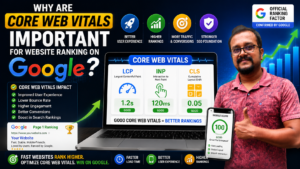
Most website owners think about SEO in terms of keywords, backlinks, and content. But there is a layer underneath all of that which quietly determines whetherGoogleeven considers your page worthy of a top spot inCore Web Vitals.
These are real, measurable performance signals that tellGoogleandincreasingly AI search platforms whether your page actually delivers a good experience. Not a theoretically good experience. A good experience for real users on real devices in real network conditions.
Ignore them, and your content competes with one hand tied behind its back.
Table of Contents
- What Are Core Web Vitals?
- What Are Core Web Vitals Scores?
- Important Core Web Vitals Tools
- Why Are Core Web Vitals Important?
- Do Core Web Vitals Directly Improve Google Rankings?
- How Do Core Web Vitals Affect AI Overview Visibility?
- Why Do I Prioritize Core Web Vitals as an SEO Service Provider?
- Common Core Web Vitals Problems I Find During SEO AuditsLCP failures (most common):INP failures:CLS failures:
- LCP failures (most common):
- INP failures:
- CLS failures:
- My Experience as an SEO Expert in Kolkata
- FAQs
- LCP failures (most common):
- INP failures:
- CLS failures:
What Are Core Web Vitals?
Core Web Vitalsare three specific metrics.Googleuses to measure real-world page experience. They are not any opinions, they are numbers, collected from actual Chrome users through theChrome User Experience Report (CrUX).
Googlerates each metric as Good, Needs Improvement, or Poor. To passCore Web Vitals, at least 75% of your real visitors must score “Good” on all three metrics.
The three metrics are the following:
- LCP — Largest Contentful Paintmeasures how quickly your main content loads, typically a hero image or headline. Target under2.5 seconds.
- INP — Interaction to Next Paintmeasures how quickly your page responds to user interactions, clicks, taps, and keyboard inputs. Target: under200 milliseconds. INP replaced First Input Delay (FID) in March
- 2024. Any guide still listing FID is outdated.
LCP — Largest Contentful Paintmeasures how quickly your main content loads, typically a hero image or headline. Target under2.5 seconds.
INP — Interaction to Next Paintmeasures how quickly your page responds to user interactions, clicks, taps, and keyboard inputs. Target: under200 milliseconds. INP replaced First Input Delay (FID) in March 2024. Any guide still listing FID is outdated.
- CLS — Cumulative Layout Shiftmeasures how much the page layout jumps around while loading ads appearing, images shifting, and fonts swapping. Target: under0.1.
CLS — Cumulative Layout Shiftmeasures how much the page layout jumps around while loading ads appearing, images shifting, and fonts swapping. Target: under0.1.
A critical detail most articles skip is thatCore Web Vitalsuse field data. Google grades you onCrUXat the 75th percentile across a 28-day rolling window. A perfect Lighthouse score in your dev tools means nothing if real users on mid-range phones get slow results.
That last point matters enormously for businesses targeting users inIndia, where mid-range Android devices and variable network speeds are the norm, not the exception.
What Are Core Web Vitals Scores?
As of the May 2026CrUXrelease,55.9% of all tracked originspass all threeCore Web Vitals. The individual metric pass rates were:68.6% good LCP,81.3% good CLS, and86.6% good INP.
Broken down by device:
57.1% of websites pass Core Web Vitals on desktop, compared to only49.7% on mobile(DebugBear, October 2025 CrUX data).
Scoring thresholds at a glance:
Important Core Web Vitals Tools
You can’t improve what you don’t measure. These are the tools that matter:
- Google Page Speed Insights— Free. Shows both lab (simulated) and field (CrUX) data for any URL. The field data tab is whatGoogleactually uses for ranking signals.
Google Page Speed Insights— Free. Shows both lab (simulated) and field (CrUX) data for any URL. The field data tab is whatGoogleactually uses for ranking signals.
- Google Search Console — Core Web Vitals Report— Shows which pages are “Good,” “Needs Improvement,” or “Poor” based on real user data. Groups pages by issue type, making prioritization straightforward.
Google Search Console — Core Web Vitals Report— Shows which pages are “Good,” “Needs Improvement,” or “Poor” based on real user data. Groups pages by issue type, making prioritization straightforward.
- Chrome Dev Tools— Developer-facing tool for diagnosing LCP, INP, and CLS at the element level. Useful for finding the specific resource causing the failure.
Chrome Dev Tools— Developer-facing tool for diagnosing LCP, INP, and CLS at the element level. Useful for finding the specific resource causing the failure.
Prithu Roy Chowdhury (Adrij)
Professional SEO freelancer and digital marketer in Kolkata & Habra. Over 70+ completed client projects and 2,000+ ranked keywords across local and national search engines.